Family Medicine · Model history
Low back pain after lifting furniture: a model family medicine history
- Setting
- Primary care clinic
- Patient
- Mr. Green, 34, has had low back pain for four days since lifting heavy furniture.
- Listen
- 3 min
After listening
Say the next question
Read the patient’s answer, say your next question aloud, then reveal the model.
“It stays in my back. It doesn't go down my legs at all.”
Ask specifically about numbness, tingling, or weakness in the legs or feet.
Any numbness, tingling, or weakness in your legs or feet?
Model interview
Full transcript
- Doctor
Mr. Green, I'm Dr. Alvarez. What's brought you in today?
- Patient
My lower back has been killing me for four days, ever since I helped a friend move some heavy furniture.
- Doctor
Describe what the pain feels like.
- Patient
It's a dull, aching soreness across my lower back, but it turns into a sharp spasm when I bend over or stand up too fast.
- Doctor
Does the pain travel down either leg, or does it stay in your back?
- Patient
It stays in my back. It doesn't go down my legs at all.
- Doctor
Any numbness, tingling, or weakness in your legs or feet?
- Patient
No, nothing like that.
- Doctor
Have you noticed any changes in your bladder or bowel control?
- Patient
No, everything's normal there.
- Doctor
Any fever, chills, or unexplained weight loss recently?
- Patient
No, none of that.
- Doctor
What have you tried for the pain so far?
- Patient
Just over-the-counter acetaminophen, but it's barely helping.
- Doctor
Do you have any other ongoing health conditions?
- Patient
No, I've been pretty healthy overall.
- Doctor
Any regular medicines or medicine allergies?
- Patient
No regular medicines, and no allergies that I know of.
- Doctor
What's your job like day to day?
- Patient
I'm an accountant. I sit at a desk for eight to ten hours most days.
- Doctor
What do you think is going on with your back?
- Patient
Honestly, I'm scared I slipped or ruptured a disc. I've been walking really stiffly since it happened.
- Doctor
What's making you especially worried?
- Patient
A coworker of mine hurt his back lifting boxes and ended up needing surgery. I don't want that to happen to me.
- Doctor
What were you hoping we'd do for you today?
- Patient
I was hoping for an X-ray or an MRI right away, and something strong for the pain, maybe a muscle relaxer or something stronger.
- Doctor
Let me make sure I have this right. Four days ago, right after lifting heavy furniture, you developed aching low back pain that spasms with bending or standing quickly. It doesn't travel into your legs, and you have no numbness, weakness, bladder or bowel changes, fever, or weight loss. Over-the-counter acetaminophen hasn't helped much. Is that accurate, and is there anything else?
- Patient
That's exactly right, nothing else.
- Doctor
Thank you. The good news is that your history doesn't show any of the warning signs that would call for urgent imaging. No leg symptoms, no nerve or bladder problems. Most muscle strains like this improve substantially within about four weeks without any imaging or opioids. I'm going to prescribe a short course of an anti-inflammatory, and if the spasms are severe, a short course of a muscle relaxant to take at night. I'd also encourage you to stay as active as you comfortably can rather than resting in bed, since that actually slows recovery.
- Patient
That's not really what I expected to hear, but it does make me feel a bit better knowing there's no serious damage.
Flow at a glance
The route through the history
- Invite the patient's description
- Characterize the pain and its triggers
- Screen for leg radiation and neurological red flags
- Screen for bladder/bowel and systemic red flags
- Ask what's already been tried
- Review background, occupation, medicines, and allergies
- Explore the patient's fear and expectations
- Summarize and explain why imaging and opioids aren't needed
Free · No card · No account
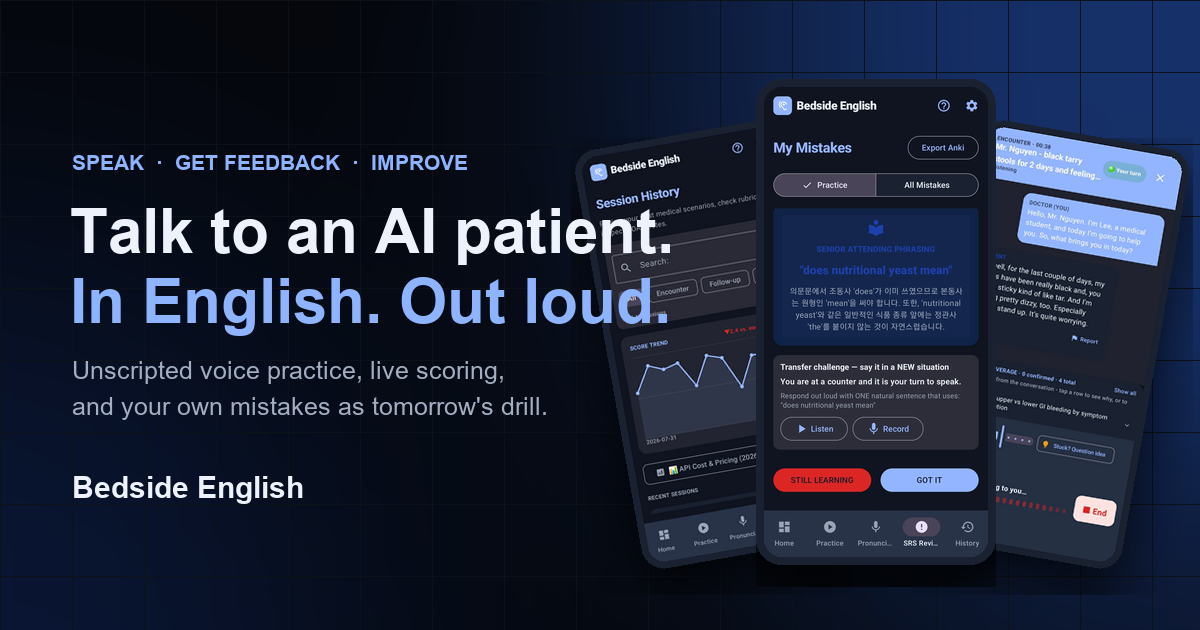
Practice this patient conversation out loud
Ask the questions in your own words, hear an AI patient respond, and use live feedback for your next speaking attempt.

Editorial record
Tied to one reviewed case
This model uses a fictional Bedside English case as its source. The page and pre-generated WAV audio are checked against the same transcript and source-case fingerprints.
Editorial update: