Emergency Medicine · Model history
A head injury during basketball: a focused emergency history
- Setting
- Emergency department
- Patient
- Mr. Yoon, 20, has headache, dizziness, and mild nausea four hours after a collision during basketball.
- Listen
- 3 min
After listening
Say the next question
Read the patient’s answer, say your next question aloud, then reveal the model.
“I remember the play and sitting on the court afterward. My teammate said I seemed confused for about a minute, but I don't have a gap in my memory.”
After brief confusion without loss of memory, ask one question about how the current symptoms have changed over time.
How have the headache, dizziness, and nausea changed since then?
Model interview
Full transcript
- Doctor
Mr. Yoon, I'm Dr. Adams. We'll keep checking your alertness while we talk. Tell me exactly what happened four hours ago.
- Patient
Another player and I collided during basketball, and his shoulder hit the side of my head. I fell down and felt dazed.
- Doctor
Did you lose consciousness at any point?
- Patient
No. I never blacked out.
- Doctor
What do you remember from just before and just after the hit?
- Patient
I remember the play and sitting on the court afterward. My teammate said I seemed confused for about a minute, but I don't have a gap in my memory.
- Doctor
How have the headache, dizziness, and nausea changed since then?
- Patient
The headache is still mild, about four out of ten, and hasn't been getting worse. I'm a little dizzy and nauseated.
- Doctor
Have you vomited or had a seizure?
- Patient
No.
- Doctor
Since the hit, have you noticed any new problem with vision, speech, strength, feeling, or walking?
- Patient
No. Bright light bothers me a little, but I can see, speak, move, and walk normally.
- Doctor
Have you become more confused or unusually drowsy, or been difficult to wake?
- Patient
No. I've stayed awake and feel clearer than I did right after the collision.
- Doctor
Do you have pain or tenderness in your neck?
- Patient
No neck pain.
- Doctor
I ask because these can change the bleeding risk: do you take a blood thinner, have a bleeding disorder, or use alcohol or drugs before the injury?
- Patient
No to all of those. I don't take any regular medicine.
- Doctor
Have you ever had a concussion or another significant head injury?
- Patient
No, this is the first time.
- Doctor
If you go home, who could stay with you and watch for a change?
- Patient
My roommate can stay with me tonight. I'm worried about a brain bleed and wonder if I need a scan. I also want to know when I can practice again.
- Doctor
You were struck on the side of the head four hours ago and were briefly confused but did not lose consciousness or lose memory. Your mild headache, dizziness, and nausea are not worsening, and you report no repeated vomiting, seizure, new neurologic problem, increasing drowsiness, neck pain, or bleeding risk. Is that correct, and is there anything else I should know?
- Patient
That's correct. Nothing else.
- Doctor
We'll complete a neurologic and neck examination and use the full findings to decide whether imaging is needed. You must not return to play today. If you go home, your roommate will receive clear written danger signs such as a worsening headache, repeated vomiting, confusion, weakness, seizure, or trouble waking you. We'll also give you instructions for classes, driving, follow-up, and a gradual return to sport only after medical clearance.
- Patient
Understood. I won't go back to practice until I'm cleared.
Flow at a glance
The route through the history
- Confirm current alertness while taking the history
- Reconstruct mechanism and timing
- Check loss of consciousness and memory
- Track symptom severity and direction of change
- Screen for neurologic and cervical-spine danger signs
- Assess bleeding risk, substances, and prior concussion
- Confirm safe observation and patient concerns
- Summarize, prohibit same-day return, and give a concrete safety net
Free · No card · No account
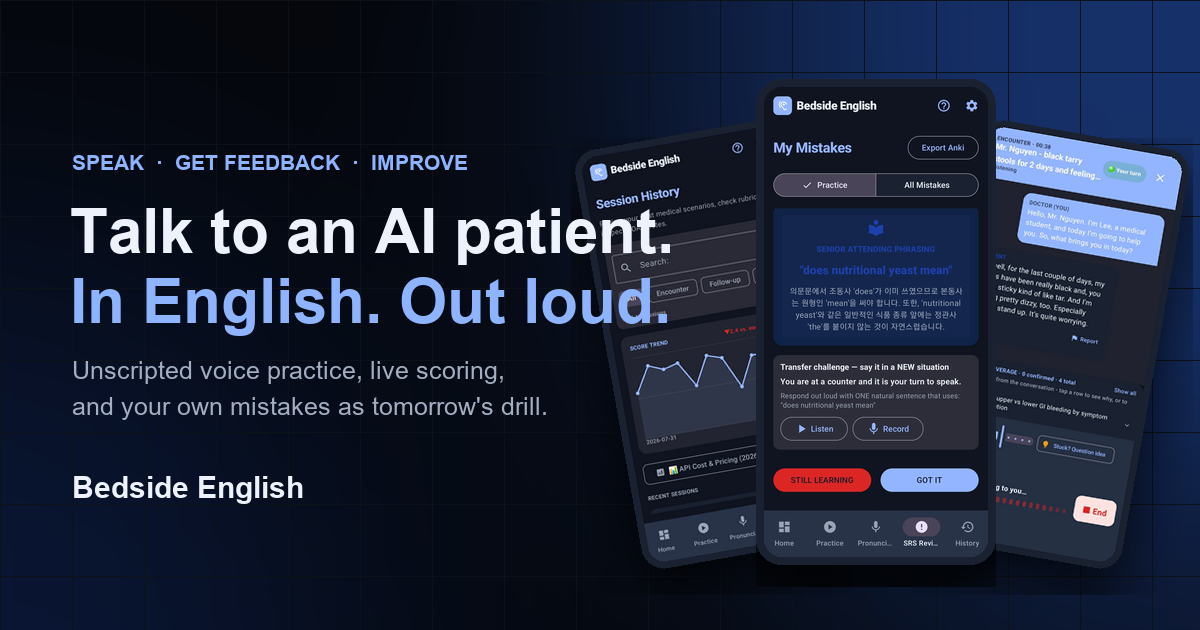
Practice this patient conversation out loud
Ask the questions in your own words, hear an AI patient respond, and use live feedback for your next speaking attempt.

Editorial record
Tied to one reviewed case
This model uses a fictional Bedside English case as its source. The page and pre-generated WAV audio are checked against the same transcript and source-case fingerprints.
- CDC ??Symptoms of Mild TBI and Concussion
- CDC HEADS UP ??Responding to a Sports-related Concussion
- CDC HEADS UP ??Returning to Sports
- ACEP ??Mild Traumatic Brain Injury Clinical Policy Resources
Editorial update: