Quick answer
What can I ask in this scenario?
Ask how many pads or tampons are used per day and whether large clots pass, whether there are symptoms of anemia like tiredness or dizziness, whether there's pelvic pressure or more frequent urination, whether the patient hopes to have children in the future, and explain that treatment options range from medication to surgery.
“How many pads or tampons do you go through on a heavy day, and do you pass any large clots?”
Communication context
A realistic patient scenario
Imagine this consultation: A patient describes heavy periods with large clots and severe cramping. Your task is to explore the history in natural English without overwhelming the patient with clinical jargon.
- Clinical area
- Obstetrics & Gynecology
- Your focus
- Clear, patient-friendly history taking
The clinical detail gives the language a realistic setting. This guide teaches communication, not diagnosis or treatment.
Useful questions for this scenario
Natural English questions, grouped by purpose
These are selected questions for this particular practice case. They are not an exhaustive clinical checklist.
Associated symptoms
“How many pads or tampons do you go through on a heavy day, and do you pass any large clots?”
Purpose: Get a concrete sense of blood loss by asking about pad or tampon use and clots.
Why this wording
Adding ‘or tampons’ to the source question makes it relevant to patients who don't use pads, and asking about the heaviest day gives a more useful number than an average.
“Have you felt more tired, dizzy, or short of breath lately?”
Purpose: Screen for symptoms of anemia, like tiredness, dizziness, or shortness of breath.
“Do you feel pelvic pressure or need to urinate more often?”
Purpose: Ask about pelvic pressure or more frequent urination, which can come from an enlarged uterus.
Why this wording
These ‘bulk’ symptoms are easy for a patient to overlook or attribute to something else entirely, so naming them specifically is often the only way they get connected back to the bleeding.
The patient's perspective
“Are you hoping to have children in the future?”
Purpose: Ask, without assuming either way, whether the patient hopes to have children in the future.
Why this wording
Treatment options differ significantly depending on the answer, so this is asked as an open, non-assuming question rather than guessed at from the patient's age or other details.
“We can discuss options ranging from medication to surgery like myomectomy or hysterectomy.”
Purpose: Explain that treatment can range from medication to surgical options like myomectomy or hysterectomy.
Put the phrases together
Move from open to focused questions
- Open
“Could you tell me more about what has been happening?”
- Focus
Choose a relevant question from the groups above.
- Check
“Is there anything else about this that you think I should know?”
Language note: Short, direct questions are often easier to answer. Ask one idea at a time, then follow the patient's wording when you need more detail.
Free · No card · No account
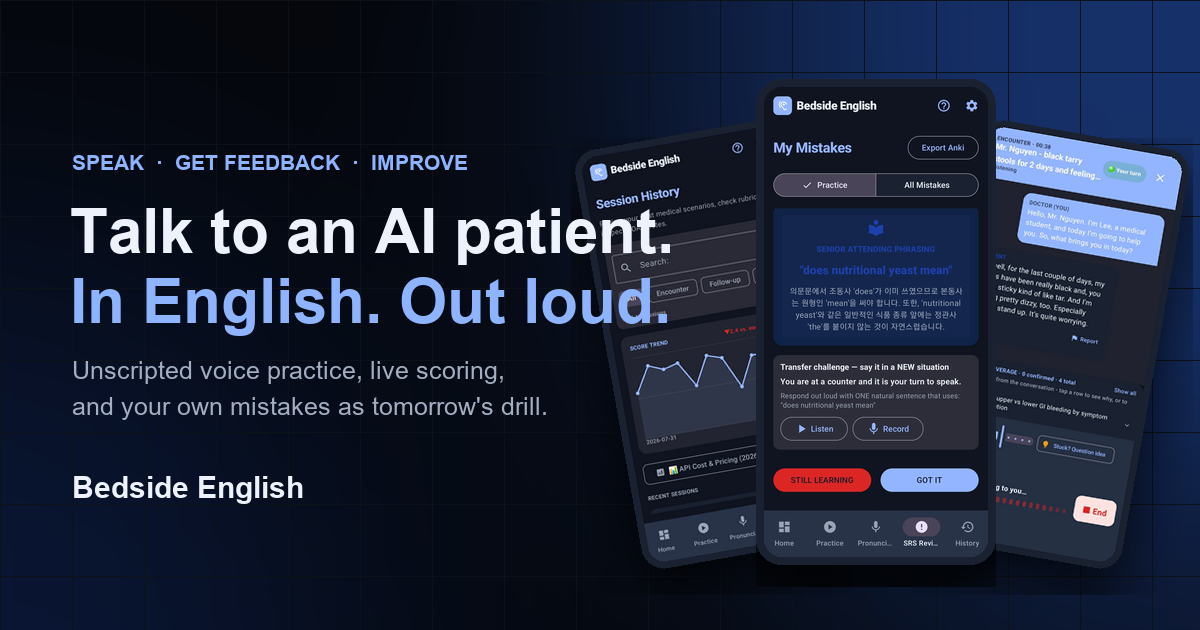
Practice this patient conversation out loud
Ask the questions in your own words, hear an AI patient respond, and use live feedback for your next speaking attempt.

Publication notes
About this guide
- Based on a simulated Bedside English clinical scenario.
- Phrases are selected and edited for patient-friendly clinical communication.
- Last editorial update: .