Quick answer
What can I ask in this scenario?
Ask what the sensation feels like, whether it happens more at rest or with activity, about caffeine, alcohol, and sleep, whether it's ever come with fainting or chest pain, about recent stress, and what the patient is most worried it could be.
“Does it feel like a missed beat followed by a stronger thump?”
Communication context
A realistic patient scenario
Imagine this consultation: A patient describes months of feeling a missed heartbeat followed by a stronger thump in the chest. Your task is to explore the history in natural English without overwhelming the patient with clinical jargon.
- Clinical area
- Cardiology
- Your focus
- Clear, patient-friendly history taking
The clinical detail gives the language a realistic setting. This guide teaches communication, not diagnosis or treatment.
Useful questions for this scenario
Natural English questions, grouped by purpose
These are selected questions for this particular practice case. They are not an exhaustive clinical checklist.
The symptom story
“Does it feel like a missed beat followed by a stronger thump?”
Purpose: Confirm the character of the sensation — a missed beat followed by a stronger thump.
Why this wording
Describing the specific pattern, a skip followed by a stronger thump, rather than asking generally ‘what does it feel like,’ gives the patient a concrete description to confirm or correct, since this exact sensation is a recognizable, common pattern.
“Do you notice this more when you're sitting quietly, or when you're active?”
Purpose: Ask whether the sensation happens more at rest or during activity.
Why this wording
This distinction matters clinically — a sensation that's more noticeable at rest, when there's less else going on to distract from it, often has a different significance than one triggered by exertion.
“How much coffee and alcohol do you have, and how are you sleeping?”
Purpose: Ask about caffeine and alcohol intake and sleep quality, all common triggers.
Associated symptoms
“Have you fainted or had chest pain with it?”
Purpose: Screen for fainting or chest pain occurring with the sensation, which would need more urgent evaluation.
Why this wording
This is asked as a direct screening question because a ‘yes’ answer changes the visit from routine reassurance to urgent workup — it's worth asking plainly rather than folding it into a general symptom review.
The patient's perspective
“What are you most worried this might be?”
Purpose: Ask directly what the patient is most worried this might be.
Why this wording
Asking this directly, rather than assuming the patient is either anxious or unconcerned, lets you address their actual fear — which for this symptom is very often a worry about a serious heart problem, even when the pattern described is reassuring.
Daily life and context
“Has anything been particularly stressful recently?”
Purpose: Ask about any recent stress, since it's a common trigger.
Put the phrases together
Move from open to focused questions
- Open
“Could you tell me more about what has been happening?”
- Focus
Choose a relevant question from the groups above.
- Check
“Is there anything else about this that you think I should know?”
Language note: Short, direct questions are often easier to answer. Ask one idea at a time, then follow the patient's wording when you need more detail.
Free · No card · No account
Practice this patient conversation out loud
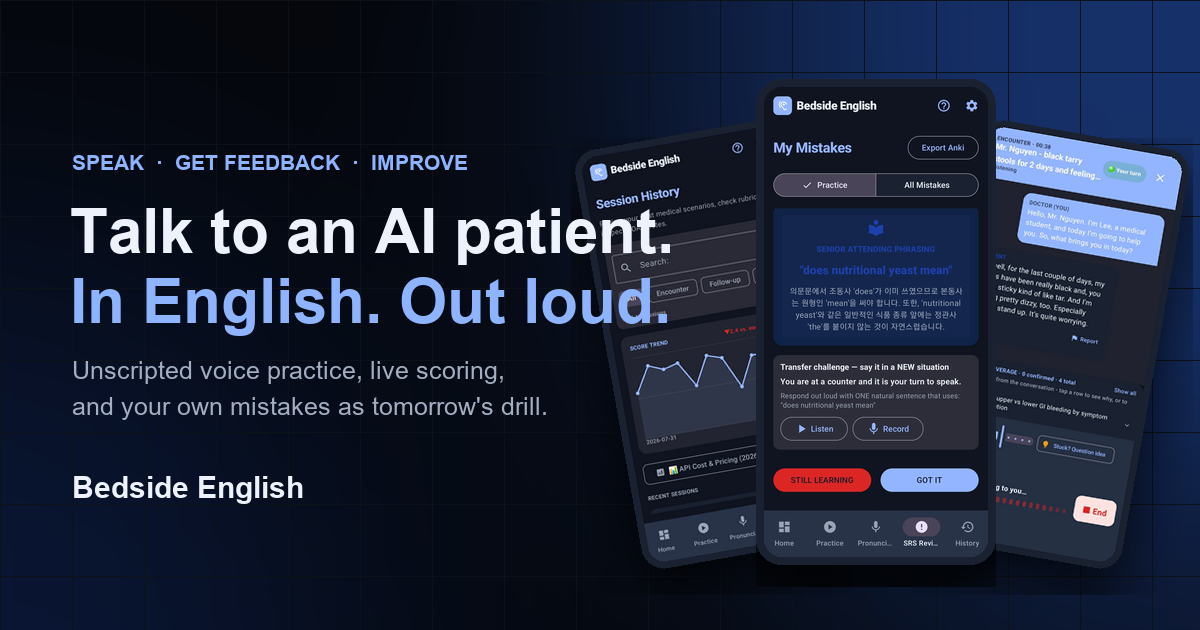
Ask the questions in your own words, hear an AI patient respond, and use live feedback for your next speaking attempt.

Publication notes
About this guide
- Based on a simulated Bedside English clinical scenario.
- Phrases are selected and edited for patient-friendly clinical communication.
- Last editorial update: .