Quick answer
How can a doctor use SBAR for a specialty consult?
For a doctor-to-doctor SBAR consult, open with the patient, immediate problem, and reason for referral. Give only the background that affects the consultant's decision, summarize the most relevant examination and test findings, then state your working assessment and exact request. End by confirming when the specialist will review the patient and what should happen while you wait.
The communication task
Know who is speaking, why, and what needs to happen
Emergency department during an evening shift
Emergency medicine resident who assessed the patient
On-call general surgery resident
CT findings and examination are concerning for acute appendicitis
Request a timely surgical assessment and confirm the interim plan and ownership
Fictional training scenario: Names, observations, and timings below are invented for language practice. In clinical work, use the actual chart, local escalation policy, and your scope of practice.
Before you call
Read the example chart, then decide what matters
The chart contains more detail than a spoken message needs. Items marked Must say are carried into the generated SBAR example below.
Acute care communication snapshot
Current concern
- Patient
- Ms. Rivera · 34 years old · ED bed 7 Must say
- Presenting problem
- 18 hours of migrating right lower quadrant pain with vomiting Must say
- Latest observations
- HR 102 · BP 118/72 · Temp 38.1°C · SpO2 99% room air Must say
- Focused examination
- Right lower quadrant tenderness with localized guarding Must say
Relevant background
- Relevant history
- No previous abdominal surgery; no regular medication
- Pregnancy test
- Negative Must say
- Laboratory result
- White blood cell count 15.2 × 10⁹/L
- CT report
- 11 mm inflamed appendix; no abscess or free air Must say
Safety and next steps
- Working assessment
- Acute appendicitis without a complication seen on CT Must say
- Consult question
- Surgical assessment in the ED within 30 minutes Must say
- Clarify before ending
- Interim orders, escalation trigger, and named owner Must say
Build the message
Situation, Background, Assessment, Recommendation
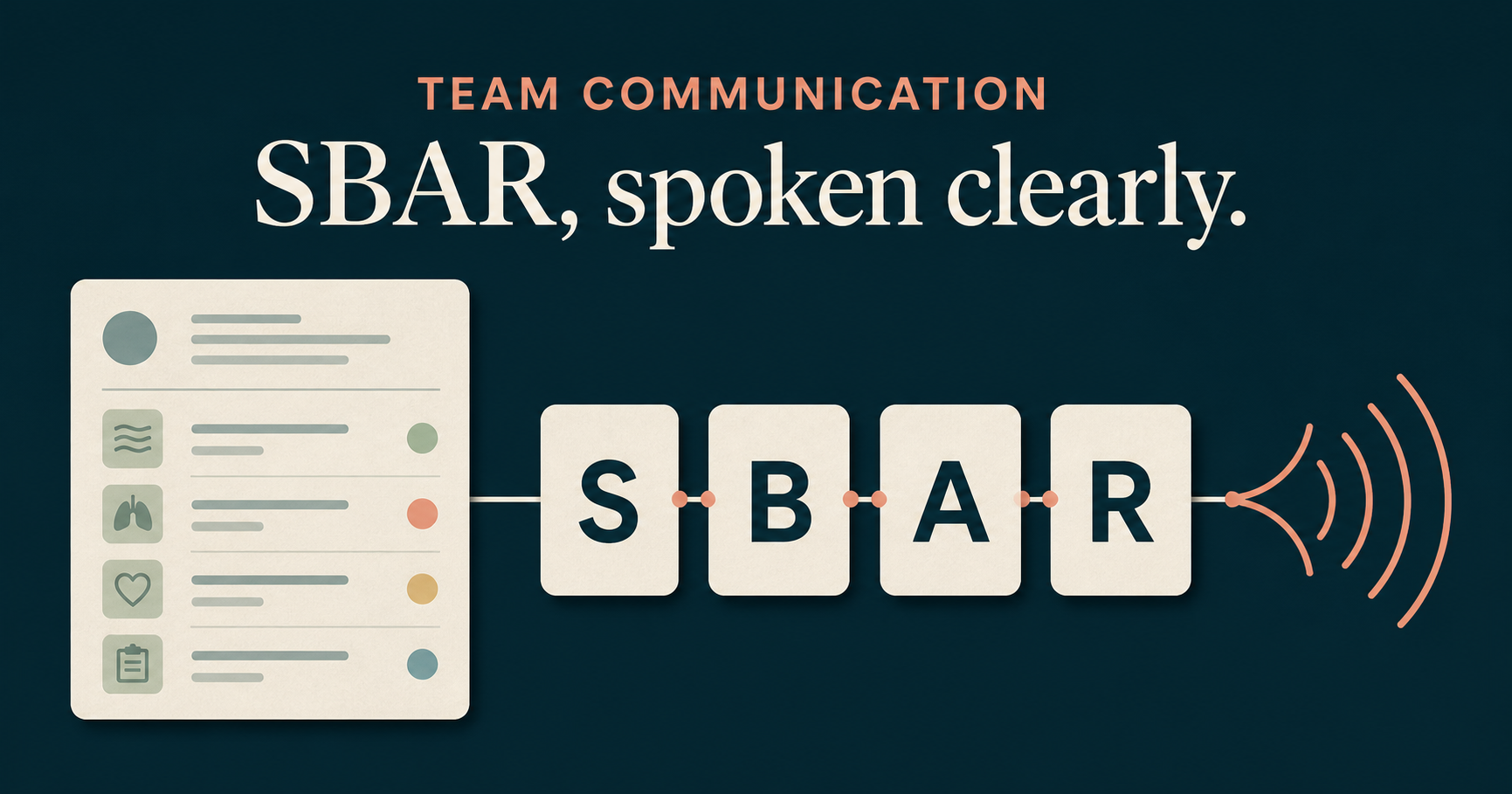
SBAR is a four-part structure for presenting a current problem, the relevant context, your assessment, and the response you are requesting. It is useful for a focused specialty consult when the consultant needs a clear clinical question rather than an unfiltered case presentation.
Who is the patient, and why do you need this consultant?
Situation
“This is Dr. Kim in the emergency department. I'm calling about Ms. Rivera, a 34-year-old in bed 7, for a surgical assessment of suspected acute appendicitis.”
Why it works: The opening identifies the caller, patient, location, service needed, and focused clinical question in one pass.
Compare the wording
“I have a patient with abdominal pain to discuss.”
“I'm calling for a surgical assessment of suspected acute appendicitis.”
The consultant can immediately judge the purpose and priority of the call.
Which history changes interpretation of this problem?
Background
“She has had 18 hours of pain that migrated to the right lower quadrant with vomiting. She has no previous abdominal surgery, and her pregnancy test is negative.”
Why it works: The background establishes the symptom pattern and relevant exclusions without turning into a complete admission history.
Compare the wording
“She has had several symptoms since yesterday, and her history is mostly unremarkable.”
“The pain migrated to the right lower quadrant over 18 hours, and her pregnancy test is negative.”
Specific chronology and decision-relevant context are more useful than a vague summary.
What are the decisive findings and your interpretation?
Assessment
“Her heart rate is 102, blood pressure 118 over 72, temperature 38.1 degrees Celsius, and oxygen saturation 99% on room air. She has right lower quadrant tenderness with localized guarding.”
“Her white blood cell count is 15.2, and CT shows an 11 millimeter inflamed appendix with no abscess or free air. My working assessment is acute appendicitis without a complication seen on CT.”
Why it works: The caller reports stability, focused examination, imaging, and interpretation while distinguishing observed evidence from the working assessment.
Compare the wording
“Everything points to appendicitis.”
“CT shows an inflamed appendix with no abscess or free air; my working assessment is acute appendicitis.”
Naming the evidence and the level of certainty helps the consultant respond to the actual case.
What do you need the consultant to do, and what must be agreed?
Recommendation
“Could you assess her in the emergency department within the next 30 minutes?”
“Before we finish, could we confirm the interim orders, what should trigger earlier escalation, and who owns each next step?”
Why it works: The request includes a location and time frame, then closes gaps in contingency planning and ownership.
Compare the wording
“Can you come and see her when you can?”
“Could you assess her in the ED within the next 30 minutes?”
A bounded request lets both physicians negotiate urgency rather than assume it.
Complete spoken example
Put the four parts together without sounding robotic
This is Dr. Kim in the emergency department. I'm calling about Ms. Rivera, a 34-year-old in bed 7, for a surgical assessment of suspected acute appendicitis.
She has had 18 hours of pain that migrated to the right lower quadrant with vomiting. She has no previous abdominal surgery, and her pregnancy test is negative.
Her heart rate is 102, blood pressure 118 over 72, temperature 38.1 degrees Celsius, and oxygen saturation 99% on room air. She has right lower quadrant tenderness with localized guarding. Her white blood cell count is 15.2, and CT shows an 11 millimeter inflamed appendix with no abscess or free air. My working assessment is acute appendicitis without a complication seen on CT.
Could you assess her in the emergency department within the next 30 minutes? Before we finish, could we confirm the interim orders, what should trigger earlier escalation, and who owns each next step?
Close the loop
“I'll review her in the ED within 30 minutes. Keep her in the department and call me sooner if her observations or abdominal findings worsen.”
“To confirm, you'll review her here within 30 minutes. I'll call sooner for worsening observations or examination findings, and I'll document the interim plan now.”
Why: The repeat-back confirms timing, location, escalation triggers, and interim ownership before the consultation call ends.
Pre-call checklist
A 20-second SBAR check
- State your name, service, patient, and location.
- Give the consult question in the first two sentences.
- Report stability and the findings that drive the referral.
- Separate test results from your working assessment.
- Ask for a specific response and negotiate timing.
- Confirm interim actions, escalation triggers, and ownership.
Common communication problems
Repair a vague or overloaded handoff
Starting a full case presentation before naming the consult question
Repair: Say which service you need and why, then provide evidence that supports that focused question.
Using “stable” without reporting relevant observations
Repair: Give the measurements or examination findings the consultant needs to judge current stability.
Ending after the consultant says “I'll see the patient”
Repair: Confirm when, where, what happens while waiting, and who owns each pending action.
Frequently asked questions
SBAR questions, answered briefly
What should a doctor say first when calling a consult?
Identify yourself, the patient and location, the service you are calling, and the focused reason for referral. The consultant should understand the task before hearing the supporting history and results.
How much background belongs in a specialty consult call?
Include history that changes the specialist's interpretation, urgency, or plan. A complete medical history may be available in the chart, but the spoken consult should foreground the details that support the clinical question.
Can the Recommendation be a question rather than a proposed treatment?
Yes. A useful recommendation can request bedside review, advice, transfer, a procedure decision, or clarification. It should still specify what response is needed, how urgent it is, and how ownership will be handled.
Free · No card · No account
Build clinical English you can say under pressure
Bedside English is designed for spoken clinical communication practice. Team scenarios are an expanding part of this learning library.

Editorial record
Sources and review boundary
This guide was drafted with a structured content template and checked against the authoritative sources below. It teaches English and message organization; it does not replace local policy, supervision, or clinical judgment.
- Tool: SBARAgency for Healthcare Research and Quality · Accessed 2026-08-24
- SBAR Tool: Situation-Background-Assessment-RecommendationInstitute for Healthcare Improvement · Accessed 2026-08-24
Published: · Last source and language review: